Why Silver Objects Catch and Hold Light
Why silver objects catch and hold light depends on finish and form; learn what suits a bright reflection, a softened gleam, or changing room light.
The common mistake is treating every silver surface as if it should shine like a mirror. That expectation can lead to needless polishing and disappointment: a softly finished bowl is not meant to return a sharp image, while a mirror-bright tray can look restless under a busy light. Why silver objects catch and hold light depends on both the surface finish and the shape carrying it.
Look first at the kind of light you want to see, then at where the object will sit. A smooth surface gives light a distinct direction to follow. A textured or satin surface scatters it across a broader area. Curves, folds, and edges decide which parts of that light reach your eye.
Choose the reflection
If you want crisp reflections, choose a highly polished surface. Its smoothness lets light bounce in a consistent direction, so nearby windows, lamps, and objects may appear as recognisable shapes. A flat silver surface can behave almost like a small, imperfect mirror.
This finish suits an object intended to feel formal or visually bright. On a tray or a simple rectangular box, a clean reflection can make the outline easy to read. The trade-off is that the reflected room becomes part of the display. A cluttered shelf or a strong overhead light may draw as much attention as the silver itself.
If you prefer a quieter gleam, look for satin, brushed, or softly textured finishes. Fine surface marks disperse reflected light, so the eye sees a broad glow instead of a sharp image. The object can still appear bright, but its brightness is less dependent on reflecting one particular lamp or window.
Choose the finish by the room’s light, not by the word “shiny” on a label.
Read the surface
Finish names describe an appearance, not a single universal process. A polished surface usually returns clearer reflections. Brushed finishes tend to show directional lines, while satin finishes often look even and subdued. Hammered surfaces break up reflections into small patches, making highlights appear varied rather than continuous.
Inspect the object from more than one angle. Tilt it gently near a window and watch whether a bright patch travels as a defined shape or spreads into a soft band. Then move it away from direct light. A strong polish may lose its dramatic glint in a dimmer spot; a textured finish can retain a legible surface because its scattered highlights do not rely on one precise viewing angle.
Small marks matter. Fine parallel lines can make a brushed finish read as deliberate, while irregular scratches on a polished area can interrupt a reflection. That distinction is not always obvious in a photograph, where bright spots and image processing may conceal the actual texture.
Match shape to light
Shape guides reflected light around an object. A broad, flat panel tends to show a large reflection, often with a clear boundary. A domed lid bends that reflection across its curve. On a rounded body, highlights may narrow into a band, then widen or shift as the surface turns away from the light.
Edges and ridges make the change easier to see. A raised rim can catch a bright line while the recessed centre stays subdued. Fluting or repeated grooves divide light into alternating bright and dark strips. These differences give an object visual depth, even when its overall finish is restrained.
For a quiet display, a rounded form with a satin finish is often a natural fit: the curve provides movement, while the surface softens sharp reflections. If you want a more graphic look, a polished flat panel or crisp raised edge makes the contrast more apparent. Neither approach is inherently better. They simply make different features visible.
Sort by setting
If the object will sit beside a window, choose according to how much reflected scenery you want. A polished surface can carry a recognisable window shape, which may suit a clean, uncluttered setting. A brushed or satin surface softens that view and is less visually insistent when daylight shifts.
If it will be displayed under a focused lamp, consider shape before finish. A curved lid or raised border can catch a deliberate highlight and give the form definition. A broad polished plane may reflect the bulb directly, which can be distracting from some viewpoints. In a softly lit room, a polished object may appear quieter than expected because there is less direct light to return.
If people will handle or move the object, think about the effect of close inspection. Mirror-like silver makes fingerprints and small surface marks easier to notice because they disturb the reflection. A softly finished surface tends to present a more even gleam, though it still deserves suitable care. For an object meant to be looked at from across a room, those small interruptions may matter less.
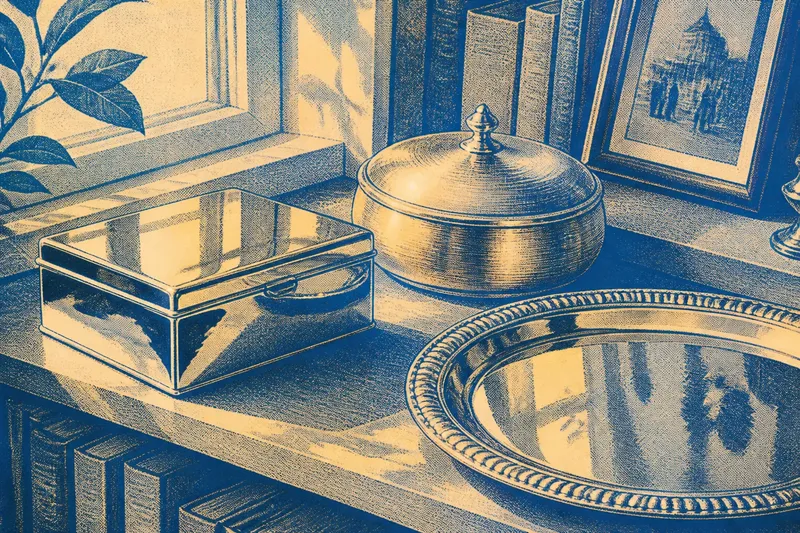
Say you are choosing between a polished silver box and a satin-finished one for a shelf beneath a bright window. Imagine the shelf also holds books and framed photographs. The polished lid is likely to reflect their shapes and the window, making the display more active; the satin lid should show a broad glow with less visual detail. If the box is meant to stand apart, the reflection may help. If the shelf already has plenty to look at, the softer finish may settle in more easily.
Notice wear and care
Polishing can change how a surface returns light, especially if the finish relies on fine lines or a deliberate texture. Repeated aggressive rubbing may blur those details or make one area look different from the rest. A bright appearance is not a reliable sign that an object needs more polishing; first ask whether the finish is meant to be reflective or diffused.
For an unfamiliar piece, check the maker’s care information and any material label before choosing a cleaning method. Silver-plated objects and mixed-material pieces may need different handling from solid silver. If the finish is uncertain or especially delicate, a qualified conservator or silversmith can advise without turning a small question into a surface change.
When you assess an object, separate the natural design of its finish from dirt, tarnish, or wear. A satin surface should not be judged by the clarity of its reflection, and a polished surface may show every interruption more plainly. Cleanliness and reflectivity are related only loosely; a surface can be well cared for without looking mirror-bright.
Questions about silver light?
Why does polished silver reflect more clearly?
A smooth surface sends reflected light in a more consistent direction, preserving recognisable shapes from the surrounding room. Fine texture scatters those rays, so the eye sees a softer glow instead of a distinct image.
Does a curved silver object look brighter?
Not necessarily. A curve moves highlights across different parts of the form, so one area may look bright while another falls into shade; the result depends on the light’s position and the viewing angle.
Can a brushed finish still gleam?
Yes. Brushed silver can look bright, but its fine lines spread reflection rather than returning a sharp image. The direction of the brushing may also make the surface appear to change as you move around it.
How can I tell a satin finish from a dull surface?
A satin finish usually has a consistent, intentional texture and an even soft sheen. A dulled or worn area may look uneven beside surrounding silver, so compare several parts of the object under the same light.
Make the final choice
For a crisp reflection, choose a smooth polish and give the object a setting worth reflecting. For a broad, restrained gleam, choose satin or brushing, especially when the light changes or the surroundings are visually busy. For shifting highlights, look for curves, ridges, and raised details that divide the light across the form.
Why silver objects catch and hold light is easiest to judge in person: turn the piece slowly, then view it in the room where it will live. The useful question is not whether it shines most, but whether its reflection makes the object’s shape easier to enjoy.