Starting a Small Silver Collection Around One Idea
A small silver collection built around one idea is easier to choose, record and revise, without turning every missing object into an obligation.
The common mistake in starting a small silver collection is buying whatever looks appealing and deciding later that it belongs together. The result is often a tray of unrelated objects, several competing explanations and money tied up in pieces the collector no longer wants. A clear idea gives each purchase a reason to stay—or a reason to pass.
A small silver collection does not need a complete pattern, a formal display or a grand historical argument. It needs a boundary narrow enough to guide choices and loose enough to survive a change of interest. Think of the theme as a working question, not a contract.
Choose a workable theme
Begin with a subject you can describe in one sentence. “Silver I like” is honest, but not useful when a dealer offers a box of mixed objects. “Small silver objects used at the breakfast table” gives you a setting, a scale and a likely group of forms to consider.
A theme can be organized around use, form, material detail, place, maker or a visual feature. It might focus on salt spoons, engraved presentation pieces, miniature household objects, or silver objects associated with one region. Each direction creates a different collection. Choose the one that leads to questions you enjoy answering, not merely the one with the most attractive display potential.
Keep the theme open at the edges. “Objects for serving tea” can include a caddy spoon, a sugar tongs or a small strainer, even if those objects differ in age and design. “Every example of a particular maker’s work” is a much narrower promise. Before adopting it, ask whether you would still enjoy the subject if pieces proved scarce, costly, or difficult to identify.
Write down a provisional theme, then name three objects that could plausibly fit and one that plainly would not. If the boundary is hard to explain, refine it before shopping.
Set the boundary
A theme needs a rule for membership. Without one, “this seems related” can expand to cover almost anything, while an overly strict rule can make the collection feel like a hunt for a missing part. A useful boundary can rely on one main feature and allow variation elsewhere.
For example, a collector interested in small objects used to serve preserves might include a jam spoon, a preserve fork and a related serving piece. The shared use matters more than matching decoration. Another collector might focus on a recognizable handle form across different utensils. In that case, use matters less than the shape.
Decide what evidence is enough to call an object a fit. A recognizable function may be clear from the form. A claim about a maker, date, region or prior owner needs stronger support, such as a readable mark or reliable documentation. Keep what you know separate from what a seller suggests or a family story remembers.
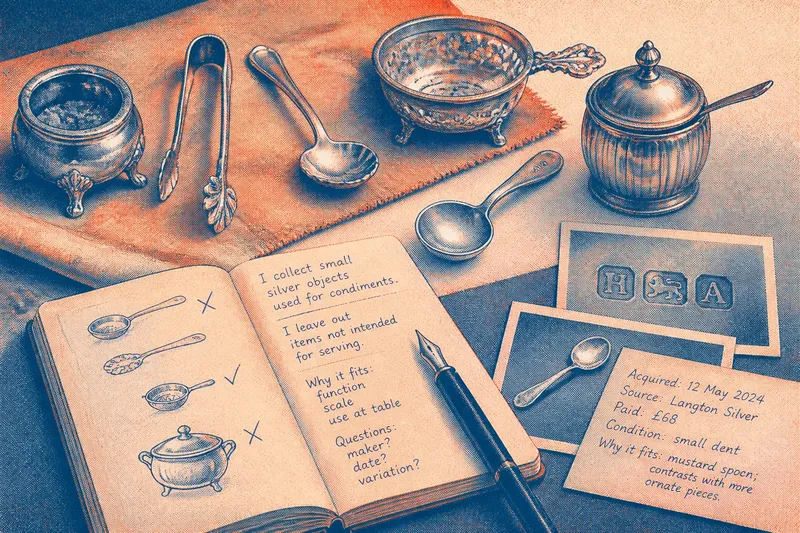
It can help to write two short lines for the boundary: “I collect…” and “I leave out…”. The second line is not a test of taste. It prevents a theme from quietly changing every time an attractive object appears.
Buy for the idea
Once the theme is clear, assess each object in relation to it rather than as a free-standing bargain or curiosity. Ask what it contributes. Does it add a new form, clarify a use, show a different approach to the same task, or raise a question you want to investigate? If the only answer is “it is silver,” the object may be better left for another collector.
Condition and authenticity still matter, but their importance depends on the object and your purpose. A small mark or repair may be acceptable in a collection about changing uses, while a damaged feature may obscure the very shape you are collecting. Examine marks and construction where you can, and be cautious about claims that cannot be checked. When identification affects a significant purchase, seek advice from a qualified silver specialist.
Set a personal limit for what you are willing to spend and for the kinds of uncertainty you can accept. The limit is not a prediction of value. It is a way to keep a collecting decision proportionate to your interest. A modest object that answers a good question can contribute more than an impressive one that pulls the collection away from its subject.
Say you are building a group around small silver objects used for condiments. You find a plain mustard spoon with a clearly legible mark, but it differs from the more ornate pieces already on your shelf. If its function fits and the mark adds a question you want to pursue, you might record it as a useful contrast rather than reject it for not matching. The observable result is a collection with a more specific story, not a claim that every piece belongs to one set.
Keep a useful record
A record need not resemble a museum catalogue. Its job is to preserve the reason for a decision while that reason is still fresh. A notebook, spreadsheet or simple card file can work. Choose a format you will actually update.
For each object, record:
- A short description, including the object’s apparent use and any distinctive form.
- Marks or inscriptions, copied as seen rather than silently expanded into a maker’s full name.
- Where and when you acquired it, with the seller or source if known.
- What you paid, if you want a record of your own expenditure.
- Condition notes, such as a dent, repair, worn edge or missing component.
- Why it fits the theme, in your own words.
- Questions that remain open, clearly separated from confirmed details.
Photographs can make the notes more useful. Take an overall image and clear views of marks or unusual details; keep the object’s identifying information with the files. A picture cannot replace a written observation, but it can help you recognize what changed or what needs checking later.
Write “possibly used for…” when function is uncertain. That small qualification protects the record from turning a guess into a fact through repetition. If a later source changes your understanding, add a dated note rather than erasing the earlier reasoning.
Leave room to change
A collecting theme should guide attention, not forbid curiosity. As the group grows, you may discover that the most interesting question is not the one you began with. A collector drawn to engraved objects might become more interested in how the engraving marks a gift or a personal occasion. The collection can shift without pretending the earlier choices were mistakes.
Make room for that shift by treating the theme as revisable. Keep a short note about what you currently mean by it, and update the note when your focus changes. Objects already collected can remain part of the story, move to a separate group, or be sold or given away. None of those decisions requires an apology.
Resist the pressure to make the group complete. Completeness can mean a matching service, a full sequence of forms, every known example by a maker, or simply a shelf with no obvious gap. Each version creates a different obligation. If a collection’s appeal depends on an endless list of missing pieces, narrow the goal or change the question.
A useful collection can show contrasts and unanswered questions. A pair of similar spoons with different handles may invite comparison; one unusual piece may expose the limits of what you know. The point is not to force a tidy account from the objects. It is to make informed choices about which questions deserve space.
Questions collectors ask?
How narrow should a silver collection theme be?
Narrow it until you can explain why a likely object fits, but leave enough variation for the theme to remain interesting. If almost every object qualifies, the boundary needs work; if nothing qualifies, broaden it.
Should every object match the others?
No. A shared use, feature or question can connect objects with different decoration and construction. Matching is useful only when it is part of the subject you chose.
How can I tell whether a piece belongs?
Compare it with your written boundary and note the evidence for its function, marks or other relevant feature. If the fit depends on an unverified claim, record that uncertainty and decide whether it is acceptable for your collection.
When should I change the theme?
Change it when your questions have changed, not simply because a desired object is difficult to find. A revised theme can explain both the existing group and the direction you want to take next.
Let the idea do work
A small silver collection built around one idea becomes easier to manage when the theme affects real decisions: what to examine, what to record, what to decline and what to reconsider. It need not settle every question about an object. It should make the next decision clearer.
Before your next purchase, read the one-sentence theme and the note explaining why the last object belongs. If the new piece adds a distinct reason for interest, it may earn its place. If it only makes the collection larger, the shelf has already supplied its opinion.