The Tarnish Panic: What a Darkened Surface Does and Does Not Mean
Silver tarnish can look alarming. Learn what a dark surface may mean, what it cannot prove, and how to inspect an object without removing useful clues.
The common mistake with silver tarnish is to treat a dark patch as a verdict: either the object is ruined or it must be genuine silver. That leap can cost you surface detail, finish, or evidence about how the object was made. Silver tarnish is usually a surface change, but appearance alone cannot establish an object’s composition, condition, or past.
A week for looking
Use a week as a quiet inspection period, not as a treatment schedule. The point is to notice what is present before deciding whether anything needs to change. Put the object on a clean, dry surface with ordinary room light, and keep it away from food, drinks, and household cleaners while you look.
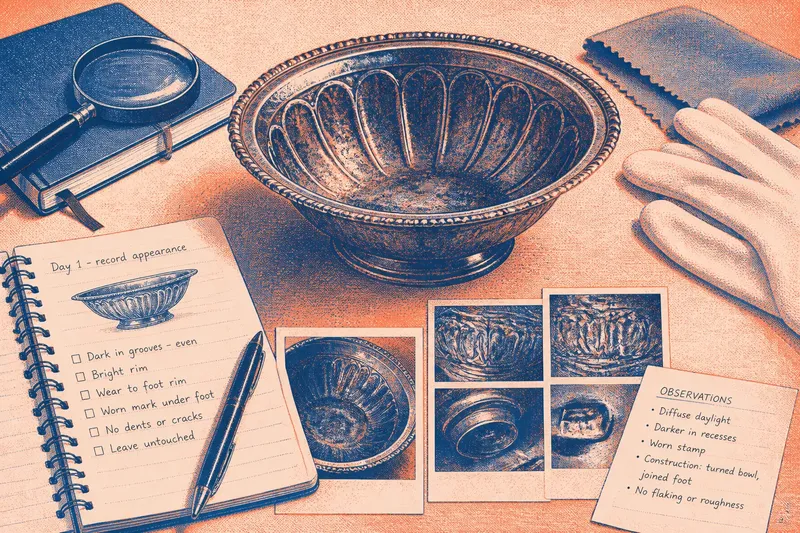
On the first day, record the object’s current appearance. Note where the dark areas sit, whether they look even or patchy, and whether the surface is reflective, matte, or patterned. Take clear photographs from several angles. Include close views of dark areas and any marks, seams, worn edges, or repairs. Do not rub a spot to see what happens.
On another day, look at the object in diffuse daylight. Strong direct light can make a faint mark look dramatic; dim light can hide a worn or uneven finish. Compare the darker areas with sheltered places such as the underside, the back of a handle, or a recess in a pattern. A difference can be useful to record, but it does not identify the material by itself.
Keep these observations in a simple note: location, shape, texture, and any change you can see without handling the surface. A record made before cleaning is more useful than a confident memory afterward.
What tarnish can tell
Silver reacts with substances in its surroundings and can develop a darker surface layer. The change may appear as a soft overall dimming, irregular patches, or dark material in grooves and engraved details. Storage conditions, contact with other materials, and prior handling can all affect where it appears.
Darkening often gathers in recessed decoration because those areas are less exposed to rubbing during ordinary use. That contrast can make engraving or chasing easier to see. It may be consistent with a surface that has not been polished evenly, but it does not prove age, careful storage, or originality. A dark line can also be dirt, residue, an applied finish, or a reaction involving another metal.
Tarnish is not the same thing as a deep scratch, a dent, a crack, or loss of plating. Those conditions concern the object’s surface or structure, and may need a different response. Look for changes in shape, lifted edges, flaking, roughness, or a sharply defined break in the finish. If a mark catches on cloth or appears to expose a different-colored layer beneath, stop handling that area and seek an informed assessment.
Material is a separate question
A darkened surface does not certify sterling silver or any other silver content. Solid silver, silver plate, and alloys can all show darkening or discoloration, while dirt and some finishes can imitate it. A polished appearance is no better as proof: an object may have been plated, coated, or recently cleaned.
Look for marks, but treat them as clues rather than a final ruling. Stamps may indicate a fineness, maker, place of manufacture, or retailer; their meaning depends on the mark and the object. A tiny stamp can be worn, unclear, or copied. Some objects have no visible mark, and absence alone does not settle the question.
Construction gives further context. Examine joins, seams, the underside, and areas where a coating might wear. A different-colored metal showing through at an exposed edge may suggest plating loss, but it is not a reliable home assay. Avoid scratch tests, acids, and abrasive probing. They can damage the object and still leave you with an uncertain answer.
Where a reliable identification matters for insurance, sale, inheritance, or conservation, ask a qualified appraiser or conservator familiar with silver. The mark, construction, and surface condition can be assessed together, rather than asking one dark patch to do the work of an examination.
When should you act?
Should every dark patch be polished away?
No. First decide whether the change is ordinary tarnish, residue, a coating, or damage. Polishing removes some surface material, so routine cleaning can soften fine detail and erase evidence of an earlier finish.
Can tarnish identify sterling silver?
No. Surface darkening is not a composition test, and several materials or finishes can look similar. Use marks and construction as clues, then consult a qualified professional if the identification affects a consequential decision.
What if the surface is flaking or rough?
Do not polish or scrape it. Photograph the area and ask a conservator or qualified silver specialist to assess whether the finish is unstable or a coating is coming away.
Is a dark object necessarily neglected?
No. Tarnish can develop during ordinary storage and use, and a dark appearance does not tell you how carefully someone treated the object. It records a surface condition, not a character reference for its owner.
A cautious cleaning decision
During the week, use the notes and photographs to decide whether cleaning is appropriate at all. If the object is stable, clearly identified, and intended for ordinary use, follow care guidance suited to its material and finish. A soft silver-polishing cloth may be appropriate for some solid silver surfaces, while plated objects, lacquered finishes, deliberately darkened details, and mixed-material pieces may call for different care.
If you cannot tell what the finish is, leave the surface as it is. Do not use baking soda, toothpaste, metal dip, or a stiff brush as a diagnostic shortcut. These can be abrasive or chemically unsuitable, especially around plating, soldered joins, and decorative darkening. Follow the maker’s care instructions where available; where the finish or composition remains uncertain, get professional advice before cleaning.
Say you inherit a small silver-colored bowl with dark grooves and a bright rim. You photograph it, note that the grooves are evenly dark, and find a worn mark beneath the foot. You leave the surface untouched and ask a silver conservator to identify the finish before polishing. The expected observable result is not a certain answer from the photographs, but a better-informed decision based on the object’s marks, construction, and condition together.
Keep the record
At the end of the week, compare the photographs with your first notes. If the surface appears unchanged and there is no flaking, exposed base metal, or structural concern, you may decide that no immediate action is needed. If the object has value beyond ordinary use, or its composition remains important and uncertain, keep the record and arrange an assessment rather than testing it yourself.
Silver tarnish is worth noticing, not panicking over. Record what the surface actually shows, separate that observation from guesses about material or history, and choose care only after you know what kind of surface you are dealing with. The untouched photograph may be the most useful first piece of care.