A Serving Spoon or a Ladle: Shape Follows the Task
Serving spoon or ladle? Compare bowl depth, rim, handle angle, and contents to choose silverware that serves cleanly without spills or awkward scraping.
The common mistake is choosing a serving spoon or ladle by size alone. A deep spoon can still leave broth behind, while a broad ladle can mash soft vegetables; the wrong bowl shape costs you control, clean serving, and sometimes a tablecloth. A serving spoon or ladle is best judged by the food it has to move and the vessel it has to reach.
When the bowl fights the food
A serving spoon usually has a shallow, oval or rounded bowl. It lifts solid or partly solid food: potatoes, beans, rice, greens, or pieces of roast. A ladle has a deeper, more cupped bowl that holds liquid as it travels from pot to plate. These are tendencies, not rigid categories. Some serving spoons are deep enough for sauced vegetables, and some small ladles are made for gravy.
Problems start when the bowl’s capacity and contour do not suit the food. A shallow spoon may carry too little sauce and leave the solids behind. A deep ladle can scoop up more liquid than the diner wants, or bring a large piece of food along for the ride.
Look at the contents before reaching for a utensil. If the serving is mostly pieces, choose a broad bowl that lets them settle in a single layer. If it is mostly liquid, choose a deeper cup that can hold a portion without requiring a careful, level-handed journey.
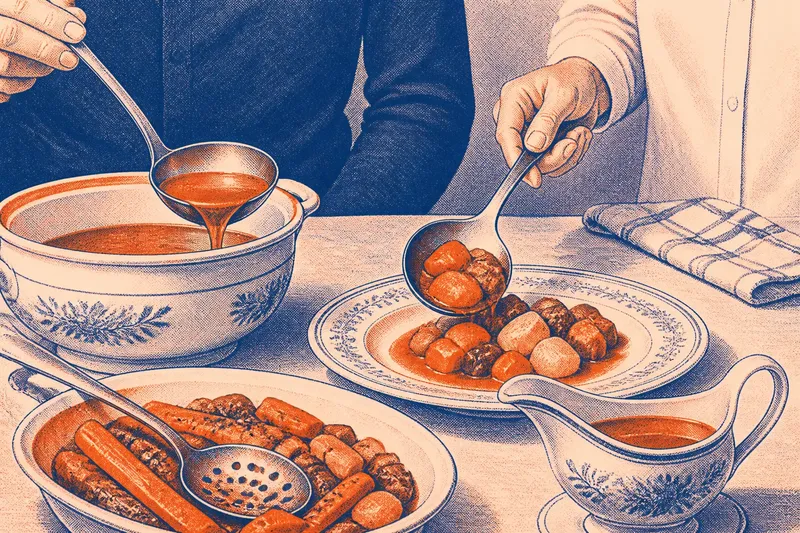
For mixed dishes, use the utensil that handles the part people need most. A shallow spoon can serve solids from a stew while a ladle supplies broth. Keep both beside the dish if guests are likely to want different proportions.
When liquid runs back
A ladle with a rounded, deep bowl can move soup, punch, custard, or gravy with less spilling than a shallow spoon. Its rim should let the contents pour in a controlled stream. A sharp, low rim can make pouring easy but may release liquid quickly; a fuller curve tends to hold more before the pour begins.
Consider the destination as well as the source. A broad tureen may allow a full ladle to turn comfortably. A narrow saucepan or small serving bowl can make a wide bowl difficult to lift and tip without brushing the rim. For gravy in a small boat, a compact ladle is often easier to manage than a large soup ladle.
If the ladle pours too abruptly, do not compensate by filling it to the brim. Take a smaller scoop and angle the bowl close to the receiving dish. If it drains too slowly, check whether the rim is meant for pouring or whether the utensil is simply better suited to dipping and transferring.
Match the ladle’s curve to the vessel opening, not just to the recipe.
When pieces slip away
A serving spoon needs enough surface area to support its food. A narrow bowl can let asparagus, sliced carrots, or a large dumpling roll off before it reaches the plate. A broad, slightly oval bowl gives pieces room to settle and makes it easier to lift a mixed portion without chasing each item around the dish.
Very shallow bowls create a different problem. They are useful for flat foods and small portions, but can lose peas, corn, or chopped vegetables as the spoon moves. For small loose ingredients, a deeper serving spoon or a slotted spoon may offer better control. A slotted design also lets liquid drain away, which matters when the goal is to serve the solids rather than the cooking liquid.
Say you are serving glazed carrots from a deep bowl. A shallow spoon may slide under a few pieces but let the glaze run across the table on the way to the plate. A deeper serving spoon should carry the pieces and a modest amount of glaze together; if guests want extra sauce, a separate gravy ladle can do that job without turning one utensil into a compromise.
Choose a slotted spoon only when draining is part of the task. Slots are less useful for rice, sauces, or foods that need their liquid to stay with them.
When the handle feels awkward
Handle form affects reach, grip, and the angle at which the bowl enters a serving dish. A serving spoon’s handle is often comparatively straight or gently curved. That arrangement works for lifting from a bowl at the table, where the user can bring the utensil toward a plate with a short movement.
A ladle handle may be longer or angled to reach into a deeper pot or tureen. A hooked end can rest on a vessel rim, keeping the bowl from sinking into the food. The hook is useful only if it fits the vessel; a shape that catches securely on one tureen may wobble or sit poorly on another.
Watch for a handle that forces the wrist into an uncomfortable turn, or a bowl that meets the food at an unhelpful angle. A long handle can help reach the bottom of a deep serving dish, but may feel unwieldy in a shallow bowl. A short handle makes table service compact, yet can bring fingers close to hot food or a warm vessel.
For an inherited or unfamiliar piece, hold it over the intended dish before serving. Check that the bowl clears the rim and that the handle leaves room for a natural grip.
When the utensil scrapes
A spoon’s edge and bowl depth determine how it meets the serving dish. A relatively flat, broad edge can gather food from the bottom of a shallow platter. A deep ladle is better for dipping, but may leave a thin layer of liquid in a flat-bottomed pot. No single profile reaches every corner.
For sauces or soft foods, a bowl with a smooth, rounded edge is less likely to catch on the dish than one with a pointed or unusually narrow end. For a broad casserole, a serving spoon with a flatter underside can slide beneath pieces more readily. The dish shape matters: a rounded bowl and a sharply squared corner rarely make a perfect pair.
Do not scrape hard against a delicate serving vessel to recover the last spoonful. Shift the dish slightly, use a utensil with a more suitable edge, or leave a thin remainder rather than risking a scratch or a clatter. If the food is difficult to reach because the dish is deep, a ladle may be the better tool even when the contents are thick.
Questions at the table?
Can a serving spoon be used as a ladle?
It can serve a small amount of thick sauce or a dish with little free liquid, provided the bowl holds the portion securely. For soup or a thin sauce, a deeper ladle usually carries more cleanly and pours with better control.
What is a gravy ladle shaped for?
A gravy ladle is generally smaller than one intended for soup, with a cupped bowl for liquid and a handle suited to a gravy boat or serving dish. The useful size depends on the vessel opening and how much sauce a diner is likely to want.
Does a slotted spoon replace a serving spoon?
Only when draining is useful. Slots let cooking liquid escape from vegetables or other solids, but they are a poor choice when sauce, broth, or small grains should travel with the food.
Which utensil suits a mixed casserole?
For a casserole with distinct pieces and some sauce, a deep serving spoon often balances support with room for a little liquid. If the dish is mostly broth, choose a ladle; if it is mostly solid pieces, choose a broader serving spoon.
Choosing by the serving
Start with three questions: Is the food mostly liquid or solid? Does it need draining? What shape and depth is the serving vessel? A ladle is the straightforward choice for liquid portions and deep dishes. A serving spoon is generally better for solid portions that need lifting, arranging, or scraping from a broad dish.
Where the dish sits between those tasks, match the bowl to the part that matters most and keep a second utensil nearby if needed. A serving spoon or ladle is not a marker of rank or ceremony. Its form is a piece of practical design: a bowl for carrying, an edge for gathering, and a handle for reaching without making dinner an exercise in balance.
When choosing among silver serving pieces, judge the bowl, rim, and handle together against the food and vessel you actually use. That simple comparison tells you more than the name stamped on a pattern.